
KSRG rules and programmes
Rope rescue in the KSRG
Here we have gathered the most important rope rescue rules and training programmes of the Polish National Firefighting and Rescue System (krajowy system ratowniczo-gaśniczy, KSRG), as set out in documents of the Chief Commandant of the State Fire Service (PSP). This is a summary to help you find your way. The documents themselves, which you can download below, are always binding. All documents are in Polish.
Documents to download
Training programmes: basic level
As of 16 November 2026
- The “Rules for organising rope rescue in the National Firefighting and Rescue System”, approved by the Chief Commandant of the PSP on 12 April 2024, are in force. They replaced the rules of September 2020.
- Basic-level training follows the “Programme of further training in rope rescue provided by the KSRG at basic level” of 29 October 2024 (consolidated text of 31 December 2025).
- Since 1 July 2026 a new Regulation of the Minister of the Interior and Administration of 24 June 2026 on the detailed organisation of the KSRG (Journal of Laws 2026, item 872) has been in force. It requires the Chief Commandant of the PSP to prepare documents on the organisation of rope rescue, including the work of specialist rope rescue groups and specialist drone groups. Documents issued under the previous regulation remain valid until they are updated.
- In February 2026 the PSP National Headquarters rope rescue team started work on updating the “Rules”. Until a new version is issued, the rules of 12 April 2024 apply.
What rope rescue is
According to the “Rules”, rope rescue means rescuing people, animals and property and removing hazards at height and below ground level, using rope techniques and specialist equipment. Rope techniques are the techniques used in mountaineering, caving and rope access.
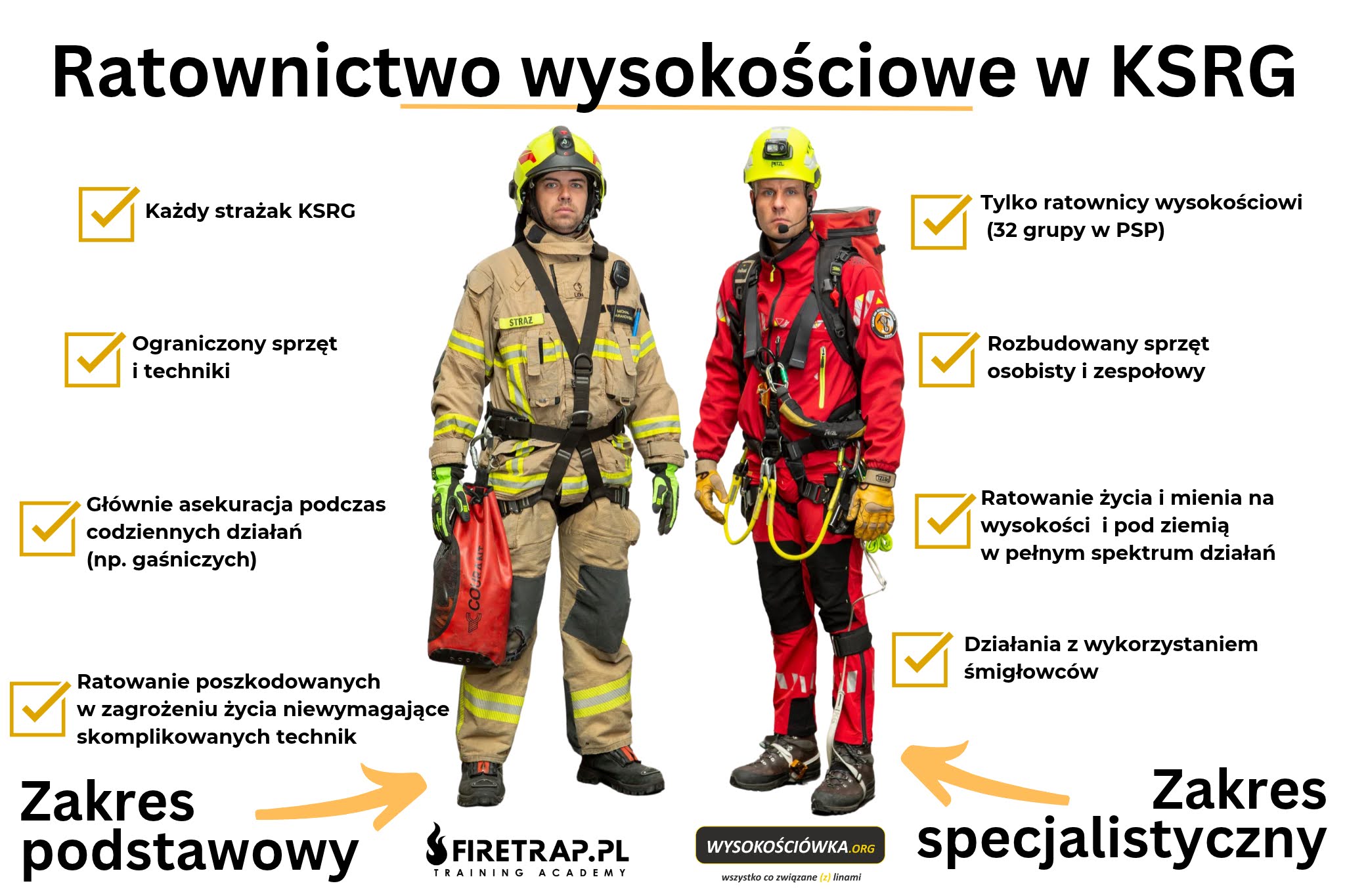
In the KSRG, rope rescue has two levels. We describe each of them separately below.
Basic level
Who: all PSP fire and rescue units, selected Volunteer Fire Service (OSP) units included in the KSRG and other bodies under contracts and agreements.
Readiness and tasks
A unit is ready for operations when at least 3 rescuers with the required qualifications can act, with suitable equipment and with immediate turnout. For planning, a turnout time of 3 minutes is assumed for the PSP and 10 minutes for the OSP.
- Reaching the scene with a belay and with fall protection equipment.
- Limiting the work area: work positioning equipment and work restraint equipment.
- Protecting the casualty against a fall with a rope, a sling or a rescue harness.
- Evacuating people, animals and property by raising, lowering or leading them out of the dangerous place.
- The same tasks on cable cars, trees and structures, but only by rescuers who have completed additional training.
Qualifications and training
Basic-level tasks are carried out by rescuers with firefighter qualifications or after further training in rope rescue provided by the KSRG, according to a programme approved by the Chief Commandant of the PSP. The “Rules” recommend that all rescuers, whatever their professional qualifications, keep up their training at this level. Operations on cable cars, trees and structures require separate further training, according to separate programmes.
Training is organised by PSP schools and the training centres of PSP provincial headquarters, according to programmes approved by the Chief Commandant of the PSP. Exercises take place on natural or artificial sites that match the hazards in the unit’s area.
Organisation
Basic-level rescue is organised by the district (city) commandant of the PSP, after a hazard analysis. Units are placed so as to cover at least 80% of the population and 80% of urban areas, with a response time of up to 15 minutes where the hazard is high, up to 25 minutes where it is medium and up to 30 minutes where it is low, with a probability of at least 80%.
Safety rules (Annex 2)
- Work at height is carried out so as to prevent falls: with work restraint systems, a top belay or a self-belay.
- The belay must take the load immediately: fall arrest starts within no more than 0.5 m.
- When a rope is loaded (abseiling, lowering, raising), a second rope is used as a belay. This is the two-rope technique: one rope is used for moving or for lowering and raising, the other as the belay.
- The anchor is the base of operations. Its strength must be well above the forces that may arise during operations, ideally at least as high as that of the other parts of the system, e.g. a knotted rope.
- The anchor is built on an anchor point: artificial (structures, machinery), natural (trees, rock) or special (a tripod).
- A sling or rope that could be damaged at the anchor point is protected with a cover or doubled.
- A single rope may be used when a second rope would reduce safety and suitable safety measures have been taken, and after further training in evacuation from cable cars, trees and structures, using the techniques taught on those courses.
Equipment
- Equipment must meet PN-EN standards and carry the CE mark.
- It is stored as a kit, in bags (except the tripod).
- Inspection and maintenance: at least once every 12 months.
Kit for the first-response appliance (Annex 3)
| Equipment | Qty | Example |
|---|---|---|
| Equipment bag | 1 | Beal Pro Rescue 60 |
| Rope bag | 3 | Beal Pro Rescue 40 |
| Low-stretch rope 50 m, 10.5–11 mm (PN-EN 1891) | 1 | Beal 10.5 mm |
| Low-stretch rope 25 m, 10.5–11 mm (PN-EN 1891) | 2 | Beal 10.5 mm |
| Sling 150 cm, min. 25 kN (PN-EN 795 B and/or PN-EN 354) | 10 | Rock Empire Open Sling Work PA 150 cm |
| Steel connector (PN-EN 362) | 15 | Petzl Vulcan Triact-Lock |
| Double pulley (PN-EN 12278) | 2 | Singing Rock Twin |
| Single pulley (PN-EN 12278) | 2 | Singing Rock Extra Roll |
| Full body harness | 3 | Singing Rock Expert 3D Speed |
| Auto-locking descender for two people (PN-EN 12841 type C) | 2 | Petzl I’D S |
| Adjustable lanyard | 3 | Petzl Grillon 3 m |
| Y-lanyard with energy absorber | 1 | Petzl Absorbica-Y MGO 80 |
| Rescue harness | 1 | Petzl Pitagor |
| Rescue tripod, recommended height min. 280 cm | 1 | Protekt TM15 |
| Rope protector | 3 | DMM K-Pro |
| Edge protector, min. 30 × 50 cm | 1 | DMM ProPad+ |
| Helmet (PN-EN 397) | 3 | Petzl Vertex Vent |
| Headtorch, recommended: min. 300 lm, IPX4 | 3 | Petzl Duo S |
We chose the equipment examples ourselves. The “Rules” do not name manufacturers, only requirements. Before you buy, check the requirements in Annex 3 and the manufacturer’s instructions.
A smaller kit (Annex 3a) is carried on turntable ladder and aerial platform appliances (SD, SH, SHD). Separate kits are described in Annexes 3b–3e: for operations on cable cars, on trees, on structures and for evacuation from a cable car using ladders.
Further training
The programme was approved on 29 October 2024 and consolidated on 31 December 2025. It replaced the programme of 9 April 2021 and prepares rescuers for the basic-level tasks described in the “Rules”.
| Topic | Hours |
|---|---|
| Rules for organising rope rescue in the KSRG, regulations and tactics | 2 T |
| Firefighting equipment and technical means | 1 T + 2 P |
| Knots and anchors | 1 T + 2 P |
| Reaching the casualty, belaying and self-belaying, emergency abseil on a single rope | 1 T + 10 P |
| Rescue and evacuation techniques | 1 T + 12 P |
| Total | 6 T + 26 P |
T means theory and P practical sessions. In total 32 teaching hours of 45 minutes. The programme recommends no more than 10 hours of sessions a day, of which no more than 8 hours of practice, and does not set the number of days.
- Entry requirements: a referral, current rescuer qualifications under the Polish State Medical Rescue Act (the Polish qualified first aid certificate, KPP), current health and safety training, suitable clothing and gloves for rope techniques. PSP firefighter: completed basic training and a current medical examination with no contraindications. OSP firefighter-rescuer: a certificate of basic training, a medical certificate and valid accident insurance (NNW).
- Training sites: climbing wall, lattice tower, roof, well, ladder or aerial platform with a basket.
- Completion: the programme has no final exam. To complete it, you must attend all sessions and pass the practical tasks on the individual skills card (49 items). Graduates receive a certificate from the training organiser.
Basic-level training programmes
The programmes were approved by the Chief Commandant of the PSP. The files open from the gov.pl website and are in Polish.
- Further training at basic levelPDF
- Further training at basic level, consolidated textPDF
- Evacuation from structuresPDF
- Evacuation from treesPDF
- Evacuation from chairliftsPDF
- Evacuation from chairlifts using laddersPDF
- Evacuation from gondola liftsPDF
All programmes, including earlier versions, are on the website of the PSP National Headquarters (in Polish).
Specialist level: SGRW
Who: specialist rope rescue groups (SGRW). They are organised by the provincial commandant of the PSP.
Readiness levels
| Level | Operational readiness |
|---|---|
| A | min. 3 rescuers: 2 rope rescuers and a commander |
| B | min. 5 rescuers: 4 rope rescuers and a commander |
| S | operations from a helicopter, together with level A or B (AS, BS) |
- Group size: at level A at least 18 rope rescuers, including 6 commanders; at level B at least 30, including 6 commanders. AS and BS groups also have at least 12 helicopter rescuers, including 6 operators.
- Response time: at level A up to 45, 90 or 120 minutes, at level B up to 60, 100 or 150 minutes, depending on the hazard (high, medium, low), with a probability of at least 80%.
Rescuers and titles
The group is made up of rescuers who hold at least the title of KSRG rope rescuer and meet the physical fitness requirements. KSRG junior rope rescuers may support operations. KSRG titles:
- KSRG junior rope rescuer,
- KSRG rope rescuer,
- KSRG rope rescue commander,
- KSRG helicopter rescuer,
- KSRG helicopter rescue operator,
- KSRG rope rescue instructor and senior instructor (instructor titles are awarded by the Chief Commandant of the PSP).
Rules for operations (Annex 4)
- SGRW operations are commanded by a KSRG rope rescue commander, a KSRG helicopter rescue operator, or a KSRG rope rescue instructor or senior instructor.
- When a fall cannot be ruled out, fall arrest equipment is used: energy absorbers, lead belay and self-retracting lifelines.
- A rope may be loaded only when mechanical, thermal and chemical hazards and the risk of overloading the system or the anchor have been eliminated.
- When a single anchor point is too weak, the anchor is built from several independent points joined with a sling or rope. The number of points depends on their quality.
- An anchor must not be built on a single expansion or chemical (resin) anchor.
- The angle between the outermost points of the anchor must not exceed 90°, and the load is spread evenly between the points.
- A rescue tripod used as an anchor requires the two-rope technique, with the second rope on an anchor independent of the tripod.
- Communication is required during operations, exercises and training: by radio, voice, hand signals or wire. Radio communication is compulsory for operations from a helicopter.
- For operations from a helicopter the basic technique is the winch and, above all, the single-rope technique.
Equipment and personal kit
The group’s equipment carries the CE mark, meets PN-EN or UIAA standards and is inspected at least once every 12 months. About 10% of the equipment is held in reserve. The group must have access to a site of at least 20 m high for rope technique exercises.
Minimum personal kit of a rescuer (Annex 5)
- helmet (PN-EN 12492 or PN-EN 397),
- harness (PN-EN 813 and PN-EN 358),
- auto-locking descender for abseiling or lowering at least two people,
- rope clamps for ascending (EN 567, EN 12841 B),
- 2 lanyards,
- 7 locking connectors and 2 non-locking connectors,
- 150 cm sewn sling,
- cutting tool, rope technique gloves and a whistle.
Further training and fitness
- Once a year a theory and practical exam and a physical fitness test, passed with at least a “good” mark: the Cooper test, about 60 m of ascending and 60 m of abseiling on fixed lines with at least 6 rebelays, pull-ups (from 10 up to the age of 30 to 7 over the age of 40).
- Every year a training and fitness camp, at least 5 days in total.
- Helicopter rescuer: at least 4 hours of exercises or flights in 2 years; an operator, at least 2 hours of this as operator.
Specialist training programmes
KSRG titles are gained on specialist courses according to programmes of the Chief Commandant of the PSP. The programmes for rescuers are consolidated texts of 31 December 2025, the programmes for instructors date from 28 October 2024. The files open from the gov.pl website and are in Polish.
- KSRG junior rope rescuerPDF
- KSRG rope rescuerPDF
- KSRG rope rescue commanderPDF
- KSRG helicopter rescuerPDF
- KSRG helicopter rescue operatorPDF
- KSRG rope rescue instructorPDF
- KSRG senior rope rescue instructorPDF
All programmes, including earlier versions, are on the website of the PSP National Headquarters (in Polish).
RWDS course
Levels L1 and L2 of our RWDS course together match basic-level rope rescue training under the KSRG rules. The equipment used on the course complies with the KSRG guidelines.