ITRA Rope Rescue
ITRA Rope RescueThe international standard for rope rescue training
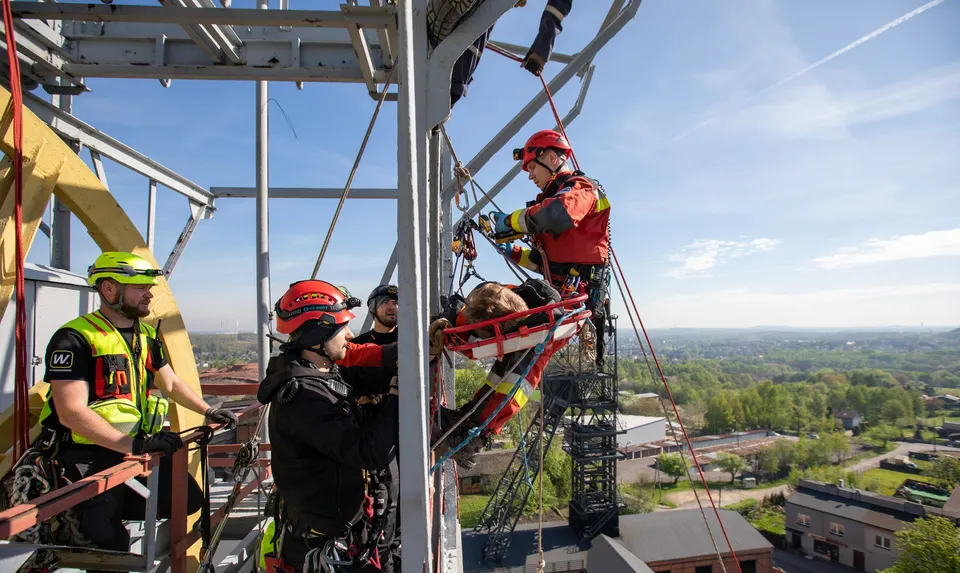
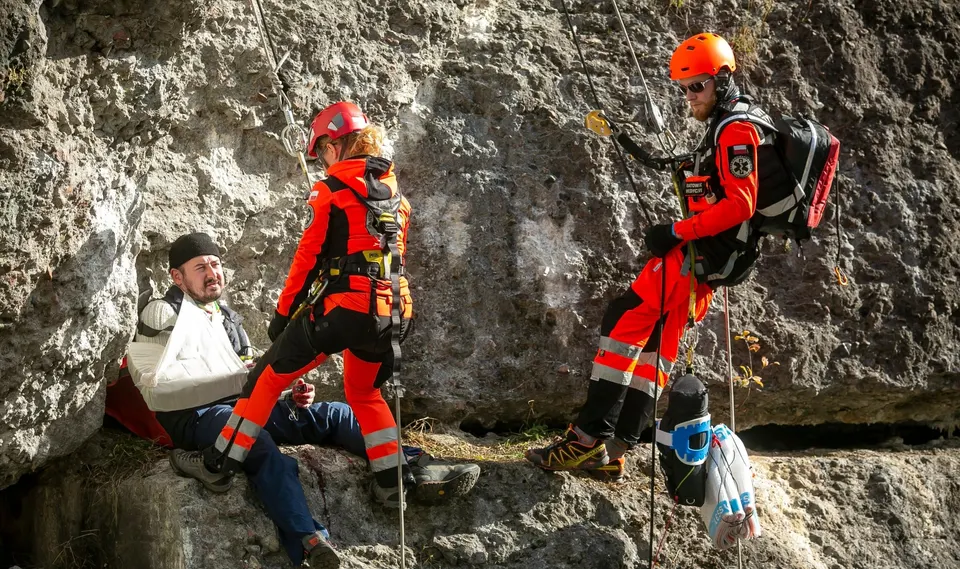
ITRA Rope Rescue is a rope rescue course for services and rescue teams: fire services, mountain rescue, uniformed services and company rescue teams. You learn to rescue people on ropes, as a team and with a casualty in a stretcher, on low-angle terrain, in vertical terrain and on Tyroleans.
ITRA has a growing number of members worldwide and operates in more and more countries. In some of them, rescue services have adopted ITRA as the standard for their training.
The course ends with an exam by an independent ITRA assessor. You get the qualification only if you pass the exam, not just for attending the course.
At a glance
- LevelsL1, L2, L3 and L1 + L2 together
- L1 Responder4 days, PLN 3,900 per person
- L2 Technician5 days, PLN 4,500 per person
- L3 Advanced5 days, PLN 4,500 per person
- L1 + L26 days, PLN 5,900 per person
- DocumentITRA certificate valid for 3 years
- VenueWarsaw or at your site
- LanguagePolish; English on request
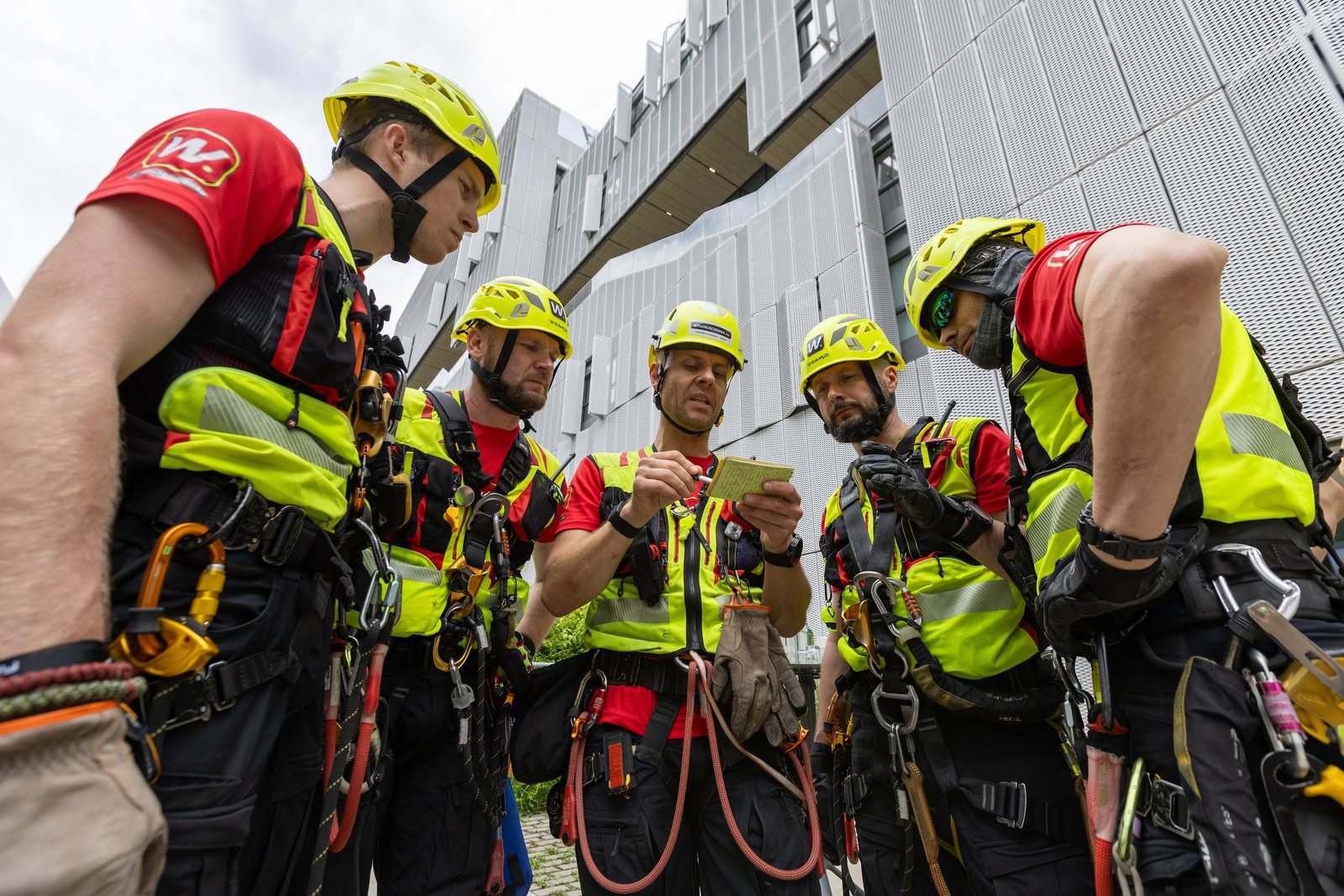
We train to the current international ITRA Rope Rescue programme. At the end of the course, the exam is run by an independent ITRA assessor.
Who is it for
The course is for those who have to rescue others where you cannot get without a rope. Above all for State and Volunteer Fire Service firefighters (PSP and OSP), GOPR and TOPR mountain rescuers and company rescue teams. It is also useful for IRATA rope access technicians who want to be able to do more than rescue a partner from their own team, and for anyone who wants to develop in rope rescue. At L1 you need no rope experience.
- fire services
- mountain rescue
- company rescue teams
- industry and energy
- uniformed services
- rope access technicians

What is ITRA
ITRA (International Technical Rescue Association) is an international non-profit organisation founded in 2018 by rescue instructors. It sets common requirements for rescuers in several disciplines, including rope rescue, swiftwater rescue and confined space rescue. As a result, an ITRA certificate at a given level means the same requirements in every country.
ITRA separates attending a course from being qualified. At the exam an independent ITRA assessor checks every element of the programme for your level. The assessor may not come from your company or unit. The qualification is entered in the ITRA database and is valid for 3 years.
The ITRA certificate is an international qualification. It is not a Polish state exam. We describe the rules of rope rescue in the Polish National Firefighting and Rescue System on the KSRG rules page.


Not all courses are equal
ITRA sets the programme and what a rescuer must show at the exam for each level. What the course itself looks like depends on the school and the instructor. An ITRA course is not Coca-Cola, which is meant to taste the same everywhere. Although apparently even Coke tastes a little different in every country… :)
A driving licence shows this best. The test is the same for everyone, yet it depends on the instructor whether after the course you drive confidently around town or just have a pass. ITRA is the same. The certificate confirms a passed exam. How you cope in a real rescue depends on who taught you and how.
We treat ITRA Rope Rescue as a rescue course, after which you are expected to save people. It is not an IRATA course with more and more complicated techniques and Tyroleans added. An English reeve looks great, but you will most likely never use it in a real rescue. There you need to save a human life efficiently and professionally.
Our instructors are serving rescuers and firefighters. We keep training ourselves, in Poland but mostly abroad, and we compete in rope rescue and rope technique competitions in Poland, the Czech Republic, Sweden, the USA, France, Belgium, Slovenia and Switzerland. We also take part in international exercises and rescue missions in various countries. Some of us started the Bezpieczny Kazbek (Safe Kazbek) project, a seasonal standby of Polish rescuers on Mount Kazbek in Georgia.
We stick to a simple rule:
Anyone who thinks they no longer need training because they know everything should not be training others.

ITRA Rope Rescue levels
L1
Responder. You work in a team with a casualty in a stretcher on low-angle terrain: a slope, a bank or an embankment. You learn the basics of your own rope work and of team rescue on low-angle terrain. You need no rope experience.
L2
Technician. You work in a team in vertical terrain: you lower and raise a casualty in a stretcher, build more complex systems and handle yourself better on the rope. ITRA requires an L1 or equivalent qualification.
L3
Advanced. You are responsible for a casualty in a stretcher moving horizontally or diagonally through the air, without support. You supervise complex techniques, assess the situation and respond to changes during the operation. ITRA requires L1 and L2 or equivalent qualifications.


Starting from scratch and want to work in vertical terrain straight away? You can do L1 and L2 together in one L1 + L2 course.
Your path in ITRA
- L1 course and exam with no rope experience
- L2 course and exam with an L1 qualification
- Or L1 + L2 straight away in one course with an exam
- L3 course and exam with L1 and L2 qualifications
- Renewal every 3 years, with an exam at your level


What you will learn
At L1 you learn the basics that every rope rescue relies on:
- knots and rescue equipment, pre-operation equipment checks
- single-point and multi-point anchors
- abseiling, ascending and self-rescue on the rope
- simple haul systems
- independent belay and safety checks
- rope and edge protection
- lowering and raising a casualty on low-angle terrain
- stretcher preparation, casualty packaging and the stretcher attendant’s work
- communication: radio, whistle and hand signals
- suspension trauma and other hazards to the casualty


At L2 you move into vertical terrain: lowering and raising a stretcher vertically, passing knots when abseiling, ascending and in systems, changing over from lowering to raising and back, artificial high directionals, simple Tyroleans, reaching and evacuating a casualty, getting a stretcher over an edge, anchors on vehicles and in the ground, releasable knots, improvised harnesses and complex haul systems. You also learn the physics of rescue: forces, angles and fall factor, and how to analyse a system and its weak points.


At L3 you add Tyroleans with stretcher height adjustment, advanced artificial high directionals, picking off a casualty suspended on a rope or in a harness, evacuating a stretcher from a wall, rope-to-rope transfers, skate block, micro haul systems, releasable anchors, climbing towers and trees, and night operations. At this level we spend a lot of time on team supervision and operation planning.


You practise everything in scenarios that resemble real operations: as a team, with a casualty and under time pressure.
How the course runs
Training days
Theory and rope work in our hall in Warsaw and at outdoor sites, following the ITRA Rope Rescue programme for your level. Including the exam, the whole course takes: L1 4 days, L2 and L3 5 days each, L1 + L2 6 days.
Last day
The exam. You will be assessed by an independent ITRA assessor.


The exam step by step
- Theory. You complete an online test of the knowledge required at your level.
- Practical. The assessor checks every element of the programme: your rope work, how you build systems and how you work in the team with the casualty.
- Result. Once you pass, ITRA enters your qualification in its database.
- Certificate. ITRA sends you an electronic certificate by e-mail. It is valid for 3 years. The exam and exam fees are included in the course price.
We run the course to the ITRA guidelines in force on the day of training. It is worth reading them on the ITRA website before the course.


Renewal every 3 years
The ITRA qualification is valid for 3 years. After that you confirm it by retaking the exam at your level. Returning trainees get a 15% discount with us.
ITRA or IRATA
IRATA teaches rope access work and rescuing a partner from your own team. ITRA Rope Rescue teaches rescuing casualties: a team operation with a stretcher on low-angle terrain, in vertical terrain and on Tyroleans. The two complement each other well. We also run the IRATA course.


Requirements
- minimum age 18,
- good physical fitness: at the exam you carry equipment, ascend and abseil with equipment and carry a loaded stretcher with your team,
- no medical contraindications to work at height and no panic fear of heights; tell the instructor about any health problems before the course,
- for L2 and L3: qualifications from the lower levels or equivalent, as required by ITRA.
You do not need to be a serving rescuer or hold the Polish qualified first aid certificate (KPP). In our view both make the material easier to understand and certainly help you be a professional rescuer. After all, this is a rescue course.
Why train with us


Training hall and outdoor sites
We train at our Training Centre at ul. Kosmatki 12 and at outdoor sites around Warsaw.
Exam included
The exam with an independent ITRA assessor and the exam fees are included in the course price.
L1 + L2 in one course
From zero to vertical rescue in 6 days, including the exam.
Instructors who work in the field
We provide safety cover for hazardous projects and train firefighters, rescuers and uniformed services.


After ITRA Rope Rescue you can take the next step with us. On the ITRA Confined Space Rescue course you learn confined space rescue, and on the Arizona Vortex course you learn to build artificial high directionals.


Venue and training at your location
As standard we train in our hall in Warsaw and at outdoor sites. We also have several other training sites in Poland, including in the Małopolska region. We can also run the training at your site or in other terrain, and outside Poland if you need it. The site and terrain must meet the requirements of the programme; we confirm that they are suitable before the training is agreed.
We run training away from our centre in Poland for groups of at least 8 participants. For such a group we do not charge for the instructors’ travel and stay or for transporting our equipment.


Frequently asked questions
Do I need experience to start?
No. For L1 and for the L1 + L2 course you need no rope experience and no previous qualifications. You learn from the basics: equipment, knots, anchors and rope work.
Do I need to be a rescuer or have first aid qualifications?
No. You do not need to be a serving rescuer or hold the Polish qualified first aid certificate (KPP). In our view both help with learning and with a rescuer's work, because this is a rescue course, but they are not required.
Can I go straight to L2?
Yes, on the L1 + L2 course. The course takes 6 days including the exam: you cover the programme of both levels in the first 5 days and take the exam on the sixth day. It is a good route if you are starting from scratch and want to work in vertical terrain straight away.
When can I take L3?
All you need is an ITRA L2 certificate. You can then take L3 straight away: under the current ITRA rules there is no minimum experience or waiting time between levels.
How does ITRA differ from IRATA?
IRATA is industrial rope access: work on ropes and rescuing a partner from your own team. ITRA Rope Rescue is rescue: a team operation with a casualty in a stretcher on low-angle terrain, in vertical terrain and on Tyroleans. The two complement each other well, and we run both courses.
What does the exam look like?
It consists of an online theory test and a practical part. The assessor checks every element of the programme for your level: rope work, building systems and working in the team with the casualty. The assessor is an independent ITRA assessor from outside our company.
How do I get my certificate?
Once you pass the exam, ITRA enters your qualification in its database and sends you an electronic certificate by e-mail.
Is the ITRA certificate a state qualification?
No. It is an international qualification confirmed by an exam with an independent ITRA assessor. We describe the rules of rope rescue in the Polish National Firefighting and Rescue System on the KSRG rules page.
How long is the ITRA certificate valid?
3 years. After that you confirm your qualification by retaking the exam at your level. If you come back to us, you get a 15% discount.
Do I need my own equipment?
No. The equipment needed for the course programme is included in the price.
How should I prepare for the course?
Read the ITRA guidelines for your level on the ITRA website and work on your fitness. At the exam you carry equipment, ascend and abseil, and carry a loaded stretcher with your team.
What does the price include?
Instructor supervision, equipment, training sites, the exam and exam fees, and issue of the certificate.
Are there discounts?
Yes, for example when several people sign up for the same date, for serving members of the uniformed services, GOPR and TOPR mountain rescuers, paramedics, nurses and doctors, and for returning trainees. Discounts and promotions cannot be combined; the highest one applies. See the Discounts page for details.
Dates and sign-up
You will find the current dates in the calendar at the bottom of this page and on the “Sign up” page. If none of the dates suits you, choose “Find a date for us” in the sign-up form and enter the number of people and the option (L1, L2, L3 or L1 + L2). We will let you know when we plan the next edition.
Course details
L1 Responder
3 days + 1 exam day (4 days in total), PLN 3,900 per person
L2 Technician
4 days + 1 exam day (5 days in total), PLN 4,500 per person
L3 Advanced
4 days + 1 exam day (5 days in total), PLN 4,500 per person
L1 + L2
5 days + 1 exam day (6 days in total), PLN 5,900 per person
- Several people on the same date: 2 people 5%, 3 people 8%, 4 or more people 11%
- Serving members of the uniformed services, GOPR and TOPR mountain rescuers: 15%
- Paramedics, nurses and doctors: 15%
- Returning trainees: 15%
- Early booking: 10% (60 days before the course) or 15% (90 days)
Training venue
WYSOKOŚCIÓWKA.org Training Centre
ul. Kosmatki 12
03-982 Warsaw, Poland